
In Association with

Licensed Under Ministry of Coorparate Govt. of
India License No. 131928

Govt. Recognised
Center For Safety Education Foundation
In Association with Bharat Sevak Samaj
Licensed Under Ministry of Coorparate Affairs Govt. of India, License No. - 131928

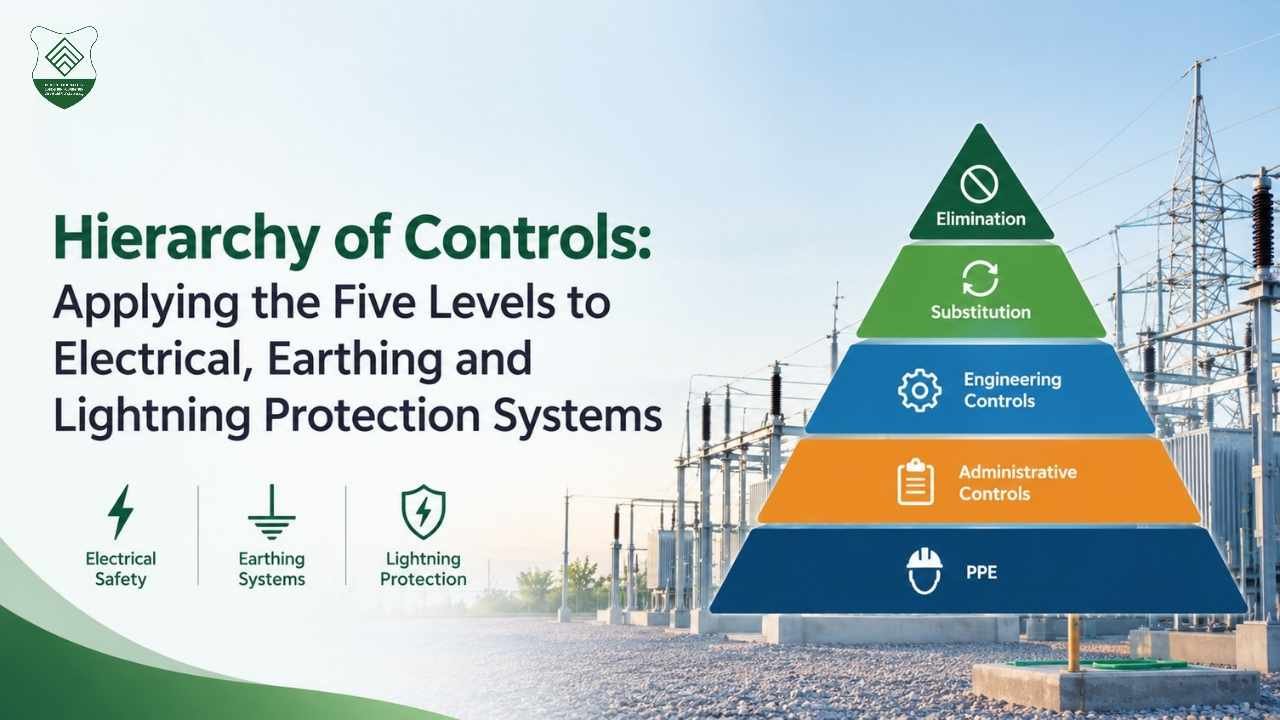
Workplace hazards cannot always be eliminated, but they can be reduced systematically. The Hierarchy of Controls ranks risk-control measures from most to least effective: elimination, substitution, engineering controls, administrative controls and Personal Protective Equipment (PPE). It is recognised in occupational health and safety practice, including ISO 45001. The Best Safety Training Centre in Kolkata can help professionals apply this ranking in risk assessments, and critical electrical infrastructure such as substations and data centres is a good place to see it at work.
Why Electrical Infrastructure Needs the Hierarchy
Substations and data centres face several linked hazards: electric shock, arc flash, fire, lightning strikes, surge damage, battery gases and SF6 gas. A degraded earthing grid can cause Ground Potential Rise (GPR), dangerous step and touch voltages, and equipment failure. Relying on one control, such as PPE or a yearly inspection, leaves gaps. The hierarchy pushes designers and safety professionals to start with the strongest controls and use the weaker ones as back-up.
Elimination
Elimination removes the hazard completely. In electrical work, the clearest example is not working live. Planned shutdowns, de-energisation and verified isolation remove the shock and arc flash hazard at the source.
Design choices can also eliminate hazards before the facility is built, such as routing underground earth conductors away from areas of future excavation or cable trenching, a known cause of severed earth connections.
Substitution
Substitution replaces a hazardous material or process with a safer one, where technically feasible. In substations and data centres, examples include:
- Fire suppression: clean-agent gaseous systems (such as FK-5-1-12 or FM-200, per NFPA 2001) in place of water-based systems in rooms with sensitive electronics.
- Earthing materials: replacing bolted or standard arc-welded joints with exothermic welded connections (IEEE Std 837), which resist thermal expansion and corrosion.
- Insulating media: SF6-free switchgear alternatives, where available, to cut gas handling and leak risks.
Engineering Controls
Engineering controls protect people through physical design, so safety does not depend on anyone remembering to act. Most of the technical measures in substation and data centre standards belong here:
- Earthing and bonding: a grid designed per IEEE Std 80 and IS 3043, with double-bonded equipment frames and a redundant mesh. The mesh gives parallel paths if one pit fails.
- Surface layering: a 100 mm to 150 mm layer of crushed high-resistivity gravel across the switchyard raises foot contact resistance and increases the safe step and touch voltage limits.
- Lightning protection: air terminals, down conductors and earth terminations per IS/IEC 62305, and shield wires and masts designed with the Rolling Sphere Method (IEEE Std 998).
- Surge protection: cascaded Type 1, 2 and 3 SPDs and gapless metal-oxide arresters (IEC 60099-4).
- Fire and gas controls: fire barrier walls, oil soak pits, nitrogen injection or high-velocity water spray systems for large transformers, VESDA smoke detection, battery room extraction ventilation, and oxygen depletion monitoring in GIS halls.
- Continuous monitoring: Earth Resistance Monitoring Systems (ERMS), smart SPDs with third-harmonic leakage monitoring, and lightning strike counters that alert SCADA or BMS/DCIM systems.
For professionals on a Safety Training Program in Kolkata, one point matters here. Earthing is an engineering control, but it degrades out of sight. Corrosion, leaching of chemical backfill, thermal shock from repeated fault currents and mechanical damage can all raise resistance without any visible sign. A single pit can still test below 1.0 Ω even when the underground loop connecting it to the grid is broken. Because the control can fail silently, it needs verification, and continuous monitoring turns periodic checking into an always-on safeguard.
Administrative Controls
Administrative controls change how people work. They are weaker than engineering controls because they depend on consistent human action, but they are essential for keeping engineering controls effective:
- Testing schedules: earth grid and pit resistance testing at least once every 12 months, ideally pre-monsoon and post-monsoon, using the Fall-of-Potential method.
- Inspections: periodic infrared thermography of earthing risers, busbar connections and arrester earth leads, and targeted inspection after severe lightning strikes.
- Safe work systems: Lockout/Tagout (LOTO) for breakers, isolators and ground switches, permit-to-work, and arc flash boundary labelling based on IEEE 1584 calculations.
- Management systems and training: ISO 45001 audits and competence training.
A yearly manual test gives one static reading. A grid disconnection or riser breakage between tests goes unnoticed. This gap is why administrative controls should back up engineering controls and not stand in for them.
Personal Protective Equipment
PPE is the last line of defence. It does not remove the hazard. For electrical work, PPE selection should follow the arc flash incident energy assessment and the task. It includes arc-rated clothing, insulated gloves, face protection, safety helmets and insulating footwear. It protects when the higher-level controls have been exhausted or have failed, and it should never replace them.
A good risk assessment identifies the hazard, evaluates exposure, and asks whether a higher-level control can be applied before relying on procedures or PPE. It also reviews the controls regularly, because ageing, environmental degradation and human error affect every system over time.
No system is perfect, but a layered approach reduces the chance and severity of failure. Professionals who take an Industrial Safety Course in Kolkata learn to select, implement and review controls across the hierarchy. For anyone looking for the Best Safety Training Centre in Kolkata, practical knowledge of the Hierarchy of Controls, applied to real systems such as earthing, lightning protection and fire safety, is the foundation of effective risk management.
Recent Post
Substation Lightning Protection and Earthing: Standards, Key Gaps and Maintenance…
HIRA vs Risk Assessment: What Every Safety Professional Should Know…