


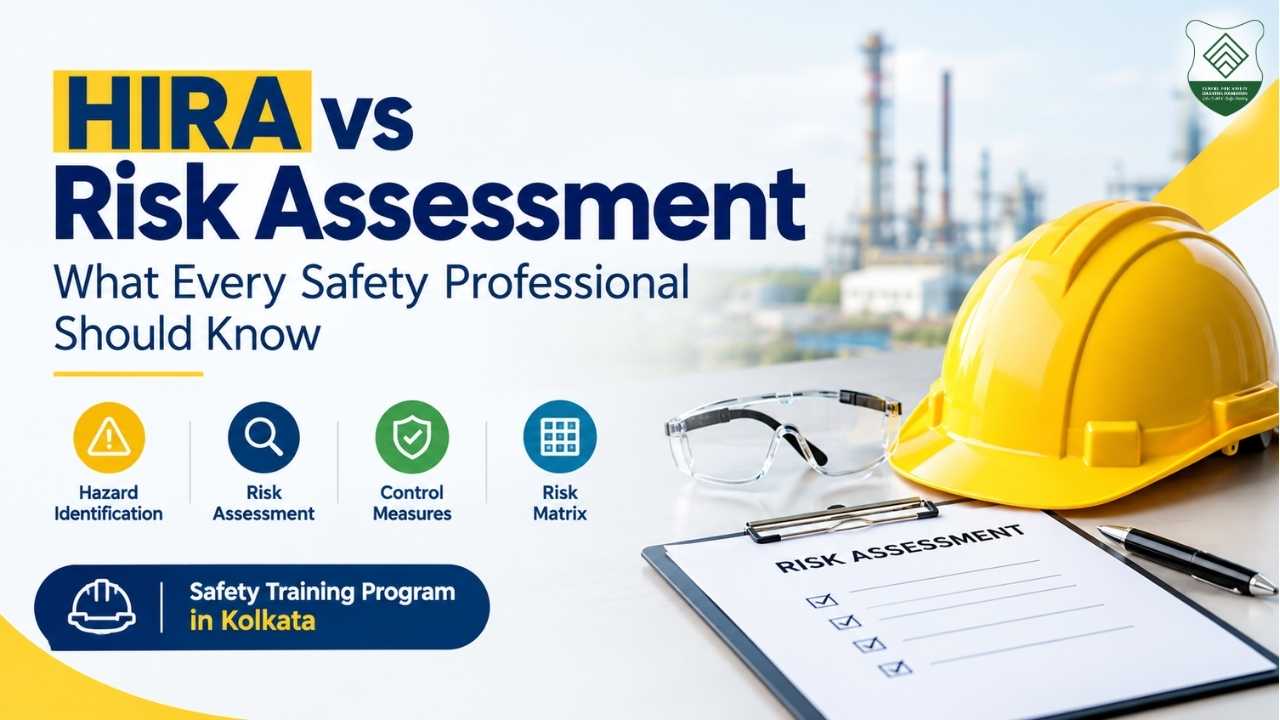
For professionals pursuing an Industrial Safety Course in Kolkata, understanding the difference between a hazard and a risk is fundamental to effective workplace safety management. Hazard Identification and Risk Assessment (HIRA) and Risk Assessment are closely related processes used to recognise workplace dangers, evaluate their potential impact and establish appropriate control measures.
What Is a Hazard?
A hazard is anything with the potential to cause harm, injury, ill health, property damage or environmental damage. Hazards can arise from equipment, materials, substances, processes, workplace conditions or human activities.
Common examples include:
- Exposed electrical wires – electrical shock or burns
- Working at height – falls from elevated surfaces
- Flammable chemicals – fire or explosion
- Moving machinery – crushing or entanglement
- Excessive workplace noise – hearing damage
- Confined spaces – oxygen deficiency or toxic exposure
Identifying the hazard is the first step towards preventing an unwanted event.
What Is Risk?
Risk refers to the possibility that a hazard will actually cause harm, considering both the likelihood of occurrence and the potential severity of the consequences.
For example, an exposed electrical cable is a hazard. The risk depends on factors such as whether workers can come into contact with it, the voltage involved, frequency of exposure and the severity of a potential electric shock.
A commonly used risk-rating approach is:
Risk = Likelihood × Severity
Organisations may use a numerical scoring system or a risk matrix to classify risks as low, medium, high or critical and determine the urgency of corrective action.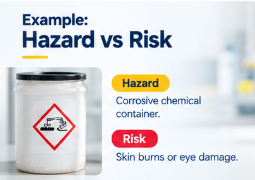
Hazard vs Risk: What Is the Difference?
The distinction can be understood with a simple example.
Hazard: An open chemical container containing a corrosive substance.
Risk: A worker may come into contact with the chemical, potentially resulting in skin burns or eye damage.
Therefore, a hazard is the source or potential cause of harm, while risk represents the likelihood and severity of harm occurring because of that hazard.
Understanding this difference is essential for safety professionals because simply identifying hazards does not indicate how urgently they need to be controlled.
What Is HIRA?
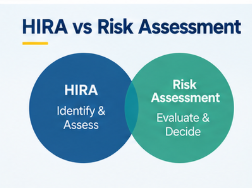
HIRA stands for Hazard Identification and Risk Assessment. It is a systematic methodology for identifying hazards associated with workplace activities and evaluating the risks arising from them.
A typical HIRA process involves:
- Breaking a job or process into individual activities.
- Identifying hazards associated with each activity.
- Determining who may be exposed.
- Identifying potential consequences.
- Assessing likelihood and severity.
- Assigning a risk rating.
- Selecting appropriate control measures.
- Reassessing the residual risk after controls are implemented.
For example, during electrical maintenance, hazards may include electric shock, arc flash and unexpected energisation. The HIRA process evaluates these hazards and determines suitable preventive measures such as isolation, lockout/tagout, appropriate engineering controls and PPE.
HIRA vs Risk Assessment: What Is the Difference?
Although the terms are frequently used interchangeably, they can have slightly different emphasis depending on an organisation’s safety management system.
HIRA places strong emphasis on systematically identifying hazards associated with specific activities and then assessing the risks arising from those hazards. Risk Assessment is the broader process of analysing and evaluating risk to determine whether it is acceptable or requires further control.
In practice, HIRA can therefore be considered an important methodology within the overall risk-management process. Both require safety professionals to move beyond simply identifying hazards and determine what controls are necessary.
How Are Risks Controlled?
Risk assessment is incomplete without deciding how identified risks will be controlled. Safety professionals commonly apply the Hierarchy of Controls, which prioritises control measures according to their effectiveness:
- Elimination: Remove the hazard completely.
- Substitution: Replace it with a less hazardous alternative.
- Engineering Controls: Isolate people from the hazard through physical or technical measures.
- Administrative Controls: Use procedures, training, warning signs, permits and work practices.
- PPE: Provide personal protective equipment as the final layer of protection.
For example, instead of relying only on PPE when workers are exposed to hazardous machinery, an organisation should first consider whether the hazard can be eliminated or controlled through machine guarding and other engineering measures.
A comprehensive Safety Officer course in Kolkata should therefore cover hazard identification, risk evaluation, control measures, residual-risk assessment and safety documentation.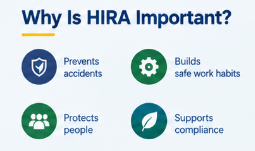
Why Is HIRA Important for Safety Professionals?
HIRA enables organisations to take a proactive approach to workplace safety. Rather than waiting for an accident to occur, safety professionals can identify potential hazards and introduce controls beforehand.
It can be applied to routine and non-routine activities such as work at height, confined-space entry, hot work, chemical handling, electrical maintenance, lifting operations and machinery operation.
For professionals undertaking a Safety Training Program in Kolkata, developing the ability to distinguish hazards from risks and apply appropriate control measures is an important practical skill. HIRA should also be reviewed whenever there are changes in equipment, materials, processes, workplace conditions or work methods.
Ultimately, HIRA and Risk Assessment work together to create a systematic approach to workplace risk management. For anyone pursuing an Industrial Safety Course in Kolkata, a strong understanding of hazards, risks, risk matrices, HIRA and the hierarchy of controls, provides an essential foundation for identifying potential harm and implementing effective preventive measures.