
In Association with

Licensed Under Ministry of Coorparate Govt. of
India License No. 131928

Govt. Recognised
Center For Safety Education Foundation
In Association with Bharat Sevak Samaj
Licensed Under Ministry of Coorparate Affairs Govt. of India, License No. - 131928

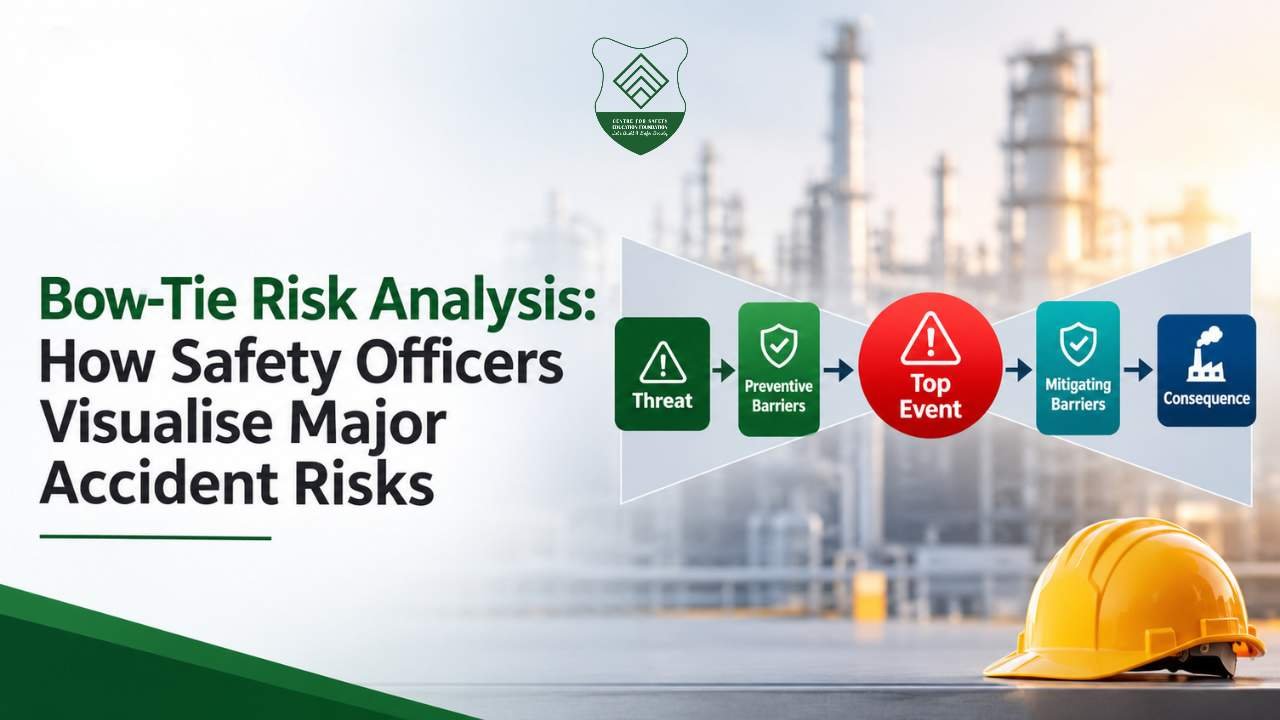
A workplace risk assessment can identify hazards, but major industrial incidents often require a deeper question: What barriers prevent a hazardous event from becoming a disaster? Bow-Tie analysis provides a structured way to answer that question. It is therefore a valuable concept for professionals pursuing a Safety Officer course and other advanced online safety training courses in Kolkata.
From Hazard to Consequence
The Bow-Tie model places the top event at its centre. On the left are the threats that could cause the top event, while on the right are the potential consequences.
For example, consider a chemical storage vessel containing a flammable substance.
A simplified Bow-Tie structure could look like:
Threat → Preventive Barrier → Top Event → Mitigating Barrier → Consequence
A threat could be overpressure caused by a process malfunction. Preventive barriers might include pressure-control systems, alarms and preventive maintenance.
If containment is lost, the top event occurs. Consequence-reduction barriers could then include gas detection, emergency shutdown systems, fire protection and emergency response procedures.
Preventive vs Mitigating Barriers
This distinction is particularly important for safety professionals.
Preventive barriers attempt to stop the unwanted event from occurring.
Examples include:
- Interlocks
- Safety instrumented functions
- Inspection programmes
- Permit-to-work systems
- Process alarms
- Competency controls
Mitigating barriers act after the top event to reduce its consequences.
These may include:
- Fire suppression systems
- Emergency shutdown
- Evacuation systems
- Blast protection
- Emergency response teams
- Spill containment
The strength of a Bow-Tie analysis depends on whether these barriers are actually independent, effective and maintained—not simply whether they appear on paper.
Barrier Failure Is Where Risk Grows
A sophisticated safety assessment should ask: What happens if the barrier itself fails?
For instance, an alarm may exist but remain ineffective if it is not tested, maintained or heard by operators. Similarly, PPE may be specified but provide little protection if workers are not trained in its correct selection and use.
This is why barrier management is closely connected to inspections, audits, maintenance, competency assessment and incident learning.
Why Safety Officers Need This Skill
A modern safety professional must move beyond identifying hazards to understanding how risks are controlled throughout an operation. A Safety Officer course in Kolkata that develops knowledge of risk assessment, barrier management and accident prevention can prepare learners for this responsibility.
Well-designed online safety training courses in Kolkata should ultimately help professionals answer not only “What can go wrong?” but also “What is stopping it—and how do we know that control will work?” That is where risk assessment becomes genuine safety management.
Recent Post
Bow-Tie Risk Analysis: How Safety Officers Visualise Major Accident Risks…
Hierarchy of Controls: Applying the Five Levels to Electrical, Earthing…