




Center for Safety Education

Categories
Safety Course

Top 8 Skills Employers Often Look for in Safety Professionals

8 Skills Employers Often Look for in Safety Professionals

A career in safety is about much more than knowing workplace rules. Employers look for professionals who can identify hazards, respond to emergencies, communicate effectively and promote a strong safety culture. Choosing the right Safety Training courses in Kolkata can help aspiring professionals develop the practical knowledge and workplace skills needed to succeed in this growing field.

Skills Employers Often Look for in Safety Professionals

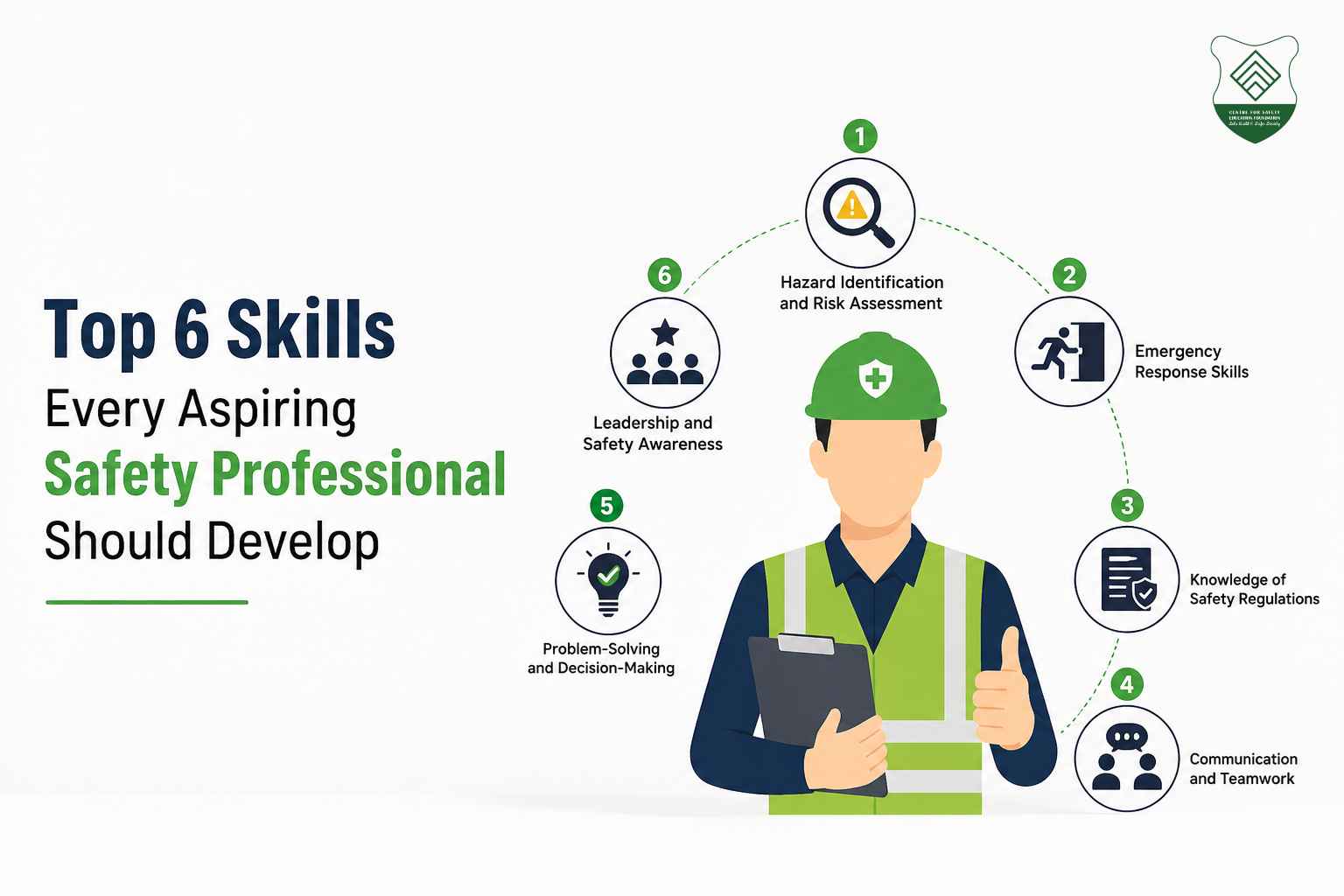
  1. Hazard Identification and Risk Assessment

One of the most important skills for a safety professional is the ability to identify workplace hazards and assess their potential risks. From machinery and electrical systems to chemicals and work-at-height activities, safety professionals must understand how to recognise hazards and recommend appropriate control measures.

Skills Employers Often Look for in Safety Professionals

  1. Strong Communication Skills

Safety professionals regularly interact with workers, supervisors, managers and emergency response teams. Clear communication is essential when explaining safety procedures, conducting toolbox talks, reporting incidents or giving emergency instructions. A good safety professional should be able to communicate technical information in a simple and practical way.

Skills Employers Often Look for in Safety Professionals

  1. Emergency Response Knowledge

Workplace emergencies can happen without warning. Employers value professionals who understand evacuation procedures, first aid, fire prevention and emergency response planning. Practical training helps professionals remain calm and make informed decisions during critical situations.

Skills Employers Often Look for in Safety Professionals

  1. Knowledge of Safety Regulations

Safety professionals need to understand applicable occupational health and safety requirements, workplace procedures and compliance standards. Strong regulatory knowledge helps organisations reduce risks, maintain compliance and create safer working environments.

Skills Employers Often Look for in Safety Professionals

  1. Problem-Solving and Decision-Making

Safety officers often have to make quick decisions when they identify unsafe conditions. Analytical thinking and problem-solving skills help them investigate incidents, determine root causes and recommend effective corrective actions.

Skills Employers Often Look for in Safety Professionals

  1. Practical Safety Skills

Employers increasingly value candidates who can apply classroom knowledge in real workplace situations. An Industrial Safety Course can help learners develop practical understanding of areas such as risk assessment, machine safety, PPE, fire prevention, safety audits, accident investigation and emergency response. Practical and hands-on learning can make candidates more confident and job-ready.

Skills Employers Often Look for in Safety Professionals

  1. Leadership and Teamwork

Safety is a shared responsibility. Professionals need to influence workers positively, encourage safe behaviour and collaborate with different departments. Leadership skills help safety officers build a workplace culture where employees actively participate in preventing accidents.

Skills Employers Often Look for in Safety Professionals

  1. Adaptability and Continuous Learning

Industrial environments, technologies and safety practices continue to evolve. Successful safety professionals stay updated with new risks, standards, technologies and best practices. A willingness to learn and adapt can significantly improve long-term career growth.


Build Your Career in Safety with Center for Safety Education


Employers seek safety professionals who combine technical knowledge with communication, leadership, problem-solving and practical skills. The right Safety Training courses in Kolkata can provide a strong foundation, while an Industrial Safety Course can help aspiring professionals prepare for real-world responsibilities and build a rewarding career in safety management.


Also read: Why Safety Education is the Backbone of a Safe Workplace?
Recent Post

Top 8 Skills…

Top 6 Skills…

Career Opportunities After…

Categories
Safety Course

Electrical Safety Training in India | OSH Code 2020 & Safety Rules 

Electrical Safety Training in India

Electrical safety is no longer optional—it is a legal, moral, and operational necessity. With the implementation of the Occupational Safety, Health and Working Conditions Code, 2020 (OSH Code 2020), workplace safety standards in India have taken a stronger, more structured form. Whether in factories, construction sites, or commercial setups, understanding electrical hazards and compliance requirements, along with an Industrial Safety Course in Kolkata is highly critical. 

Electrical incidents contribute significantly to workplace accidents and fires. Studies indicate that electrical failures are responsible for a considerable percentage of fires and fatalities globally. This highlights the urgent need for awareness, training, and strict compliance with safety regulations. 
Reference: Electrical Safety Foundation International (ESFI), NFPA Electrical Fire Statistics (2023–2024) 

Understanding OSH Code and Safety

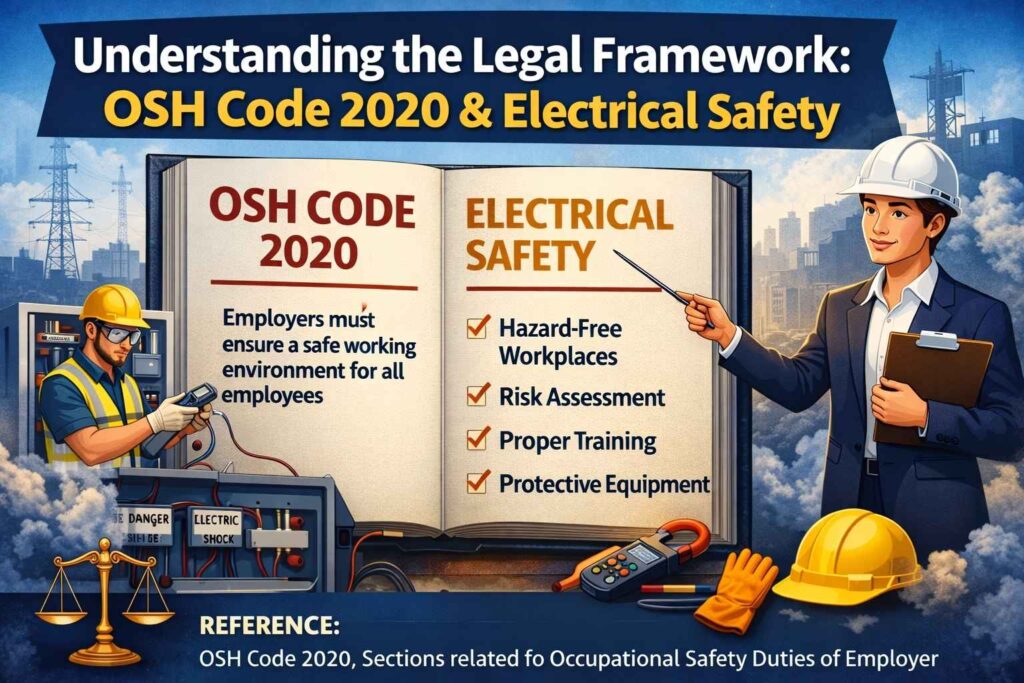
Understanding the Legal Framework: OSH Code 2020 & Electrical Safety 

The OSH Code 2020 mandates employers to ensure a safe working environment for all employees. 

Key Provisions Related to Electrical Safety: 

  • Employers must ensure hazard-free workplaces  
  • Mandatory risk assessment and hazard identification  
  • Proper training and competency of workers  
  • Use of protective equipment (PPE)  
  • Maintenance of safe electrical systems and equipment  

Reference: OSH Code 2020, Sections related to Occupational Safety Duties of Employer 

This aligns directly with the principle: 
“Every wire is a live wire unless proven otherwise.”  

Important Rules & Standards to Follow 

Electrical safety in India is governed by key regulations:

1. The Electricity Act, 2003

  • Section 146: Non-compliance can lead to penalties or imprisonment  
  • Section 149: Company officials are accountable for violations  
  • Section 151: Defines legal procedures for prosecution  

2. CEA Safety Regulations, 2010

  • Follow NEC & NBC guidelines and use standard materials  
  • Ensure safe switchgear installation with fireproof enclosures  
  • Clearly identify conductors (live, neutral, earth)  
  • Maintain proper earthing, especially for high-voltage systems  

Reference: Electricity Act, 2003 (Part XIV) & CEA Safety Regulations, 2010 

Major electrical hazards in workplaces

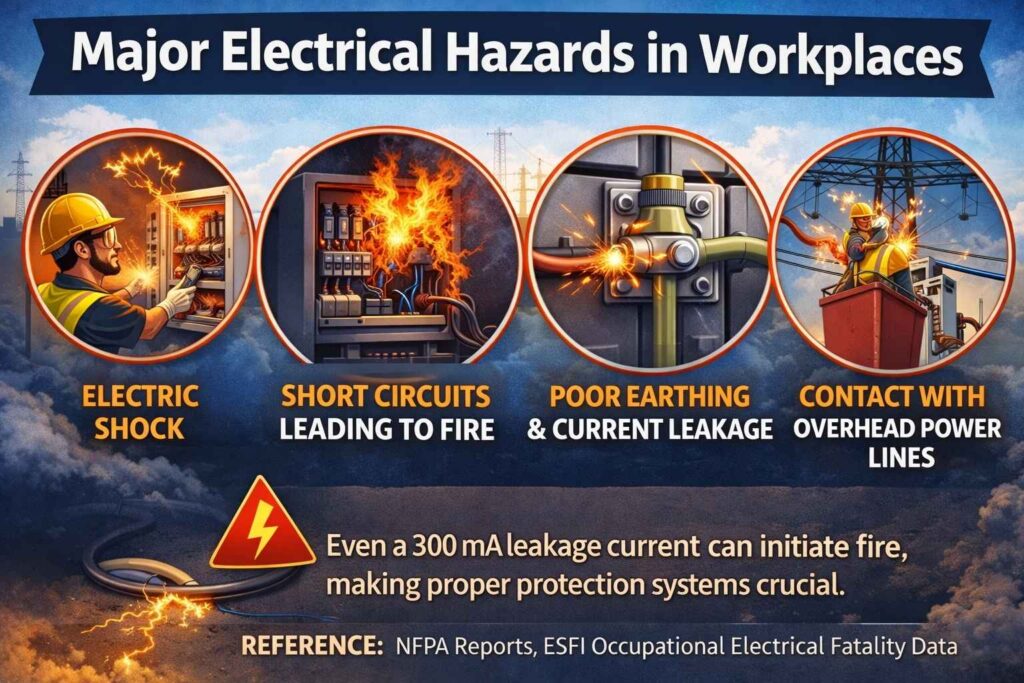
Major Electrical Hazards in Workplaces 

Electrical hazards are often underestimated but extremely dangerous. 

Common Risks Include: 

  • Electric shock (as low as 50 volts can be dangerous)  
  • Short circuits leading to fire  
  • Poor earthing causing current leakage  
  • Contact with overhead power lines (major fatality cause)  

Even a 300 mA leakage current can initiate fire, making proper protection systems crucial. 

Reference: NFPA Reports, ESFI Occupational Electrical Fatality Data 

Essential Electrical Safety Practices 

To comply with OSH Code 2020 and safety regulations, workplaces must follow: 

Risk Assessment 

  • Identify hazards before starting work  
  • Avoid working on live systems unless absolutely necessary  

Use of Safety Devices 

  • RCCB / ELCB / RCD for leakage protection  
  • Surge protection systems  

Proper Earthing 

  • Ensures fault current safely returns to ground  
  • Prevents fire and equipment damage  

Training & Competency 

  • Only trained personnel should handle electrical work  
  • Competency certification is critical  

Lockout/Tagout (LOTO) 

  • Isolate energy sources before maintenance  
  • Prevent accidental re-energizing  

Reference: OSHA Electrical Safety Guidelines, IEC Standards, IS Codes 

Why Training is the Real Game-Changer 

Rules alone don’t prevent accidents—trained people do. 

A worker may follow instructions, but a trained safety professional: 

  • Identifies hidden risks  
  • Implements preventive systems  
  • Ensures compliance with OSH Code and regulations  

As highlighted in your earlier content, the transition from worker to safety professional depends heavily on structured safety education. 

Reference: Industrial Safety Training Frameworks & Skill Development Guidelines 

From Awareness to Action: The Need for Electrical Safety Programs 

You have already conducted Electrical Safety and Fire Safety programs, which is a strong foundation. The next step is to: 

  • Standardize the training with legal compliance (OSH Code 2020)  
  • Integrate real-life case studies  
  • Include practical risk assessment modules  
  • Offer certification-based learning  

This creates a high-value paid training program opportunity. 

Electrical safety is not just about avoiding accidents—it’s about compliance, responsibility, and saving lives. With the implementation of the OSH Code 2020, organizations must go beyond basic precautions and adopt structured safety practices. 

Safety courses in Kolkata, awareness, and strict adherence to regulations like the Electricity Act 2003 and CEA Regulations 2010 are essential to build a safer workplace. 

Recent Post

Top 8 Skills…

Top 6 Skills…

Career Opportunities After…